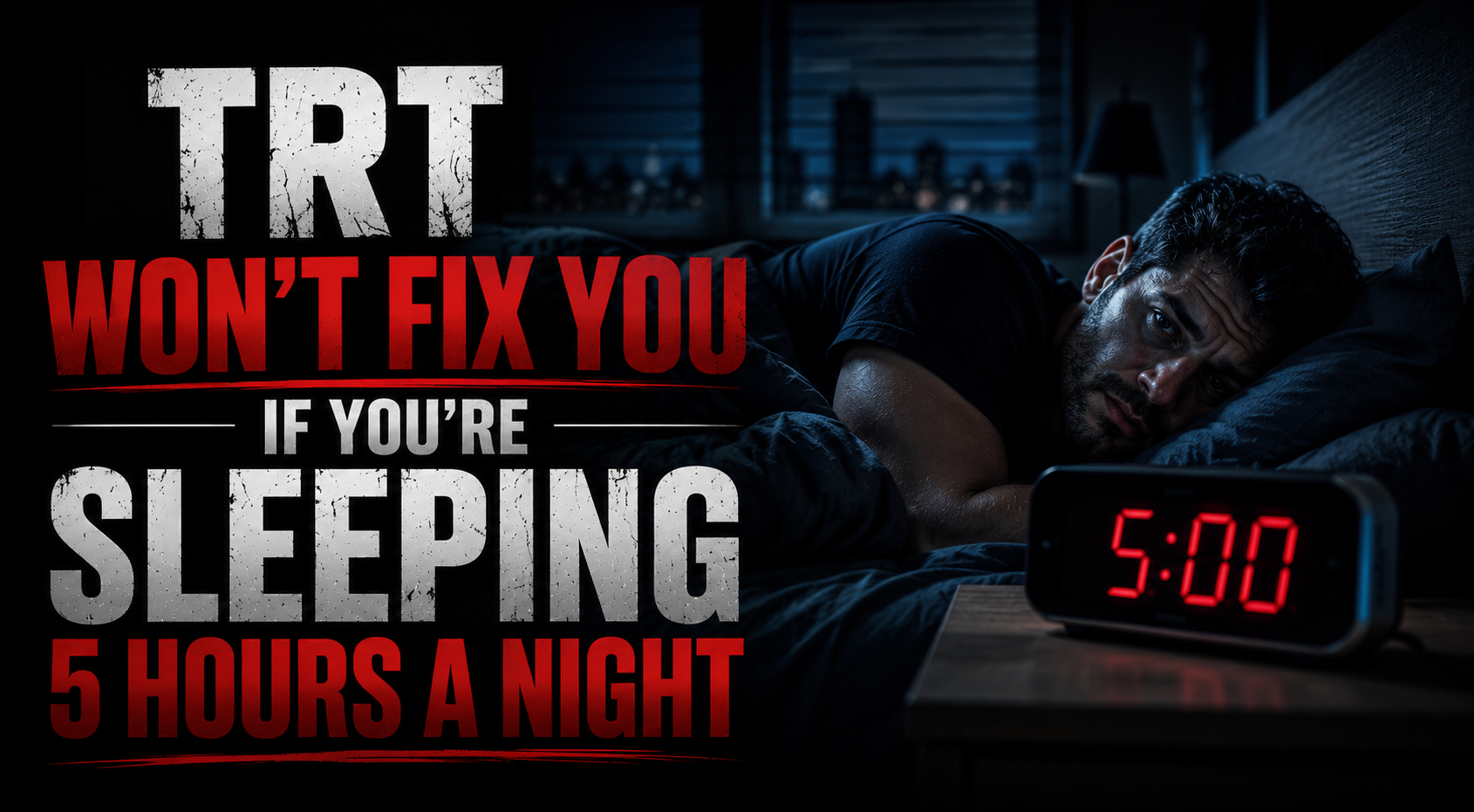
You can have “normal” or even ideal testosterone levels on paper and still feel completely drained—because if you’re only sleeping five hours a night, your body is already operating under constant physiological strain before the day even begins.
Testosterone replacement therapy (TRT) is a legitimate and often highly effective treatment for men with clinically low testosterone. However, it is not designed to compensate for poor recovery habits or fix the consequences of chronic sleep deprivation. When insufficient sleep is the root cause of fatigue, low mood, reduced libido, and poor performance, simply increasing testosterone levels will not fully resolve the issue.
Understanding this requires looking at how strongly sleep influences hormonal health—and why so many men seeking TRT may actually be dealing with an underlying sleep problem rather than a purely hormonal one.
Symptoms of Low Testosterone and Sleep Deprivation Overlap
Persistent fatigue, low sex drive, irritability, brain fog, and poor recovery are commonly associated with low testosterone. These symptoms are real and can significantly affect quality of life.
However, they are also hallmark signs of chronic sleep deprivation.
When a man consistently sleeps five to six hours instead of the recommended seven to nine, his body begins to function under a stress state that closely resembles hormonal deficiency. Energy drops, motivation declines, cognitive performance weakens, and recovery slows. Importantly, these changes are physiological—not psychological.
Without considering sleep patterns, it becomes easy to misinterpret lifestyle-driven symptoms as a testosterone problem, potentially leading to incomplete or misdirected treatment.
How Sleep Directly Impacts Testosterone Production
Testosterone production follows the body’s circadian rhythm, with the highest output occurring during sleep—particularly in deep sleep and REM stages.
When sleep is cut short, these critical hormonal production windows are also reduced. As a result, testosterone output can decline significantly even after just a few nights of restricted sleep.
Research has shown that sleeping five hours or less can lead to measurable reductions in testosterone, in some cases comparable to what is seen with much older age groups in terms of hormonal output.
Sleep loss also disrupts the broader hormonal balance. Cortisol, the body’s primary stress hormone, remains elevated when sleep is insufficient. Elevated cortisol directly suppresses testosterone production and reduces how effectively the body uses the testosterone it does produce.
Growth hormone is also heavily affected. Since it is primarily released during deep sleep, poor sleep leads to reduced tissue repair, slower recovery, and impaired metabolic function.
Why TRT Alone Cannot Fix Poor Sleep
TRT can successfully restore testosterone levels in men who are clinically deficient and often improves energy, libido, mood, and physical performance.
However, it does not correct the downstream effects of sleep deprivation.
It does not normalize cortisol rhythms disrupted by chronic stress. It does not restore deep sleep architecture or growth hormone release. It also does not reverse the cognitive effects of poor sleep, such as reduced focus, slower thinking, and decreased stress tolerance.
This is why some men start TRT expecting dramatic improvements but experience only limited results—the underlying sleep issue is still active and continuing to suppress overall recovery and performance.
In some cases, low testosterone itself can negatively impact sleep quality, creating a feedback loop where both issues worsen each other. For this reason, both sleep and hormone health need to be addressed together rather than in isolation.
The Role of Sleep Apnea in Hormone Health
Obstructive sleep apnea is a major but often overlooked factor in testosterone-related symptoms.
This condition occurs when breathing repeatedly stops during sleep, preventing the body from reaching or maintaining restorative sleep stages—even if total sleep time appears adequate.
As a result, men with untreated sleep apnea often experience severe fatigue, low mood, reduced cognitive performance, and hormonal disruption that closely mimics testosterone deficiency.
Sleep apnea also carries an additional consideration: testosterone therapy may worsen the condition in some individuals by affecting airway muscle tone and respiratory regulation during sleep.
Because of this, symptoms such as loud snoring, gasping during sleep, morning headaches, or persistent daytime fatigue should prompt evaluation for sleep apnea before or alongside TRT.
Rebuilding Sleep to Support Hormonal Health
The encouraging part is that sleep quality is highly responsive to behavioral changes.
Maintaining a consistent sleep schedule helps stabilize circadian rhythms, which regulate hormone production, energy levels, and recovery processes.
Morning sunlight exposure helps reinforce the body’s internal clock, while reducing evening light exposure supports natural melatonin production and improves sleep onset.
Caffeine intake should be managed carefully, as its effects can persist for many hours and interfere with nighttime sleep even when consumed in the afternoon.
Alcohol can also disrupt sleep architecture, reducing the depth and quality of restorative sleep even if it initially helps with falling asleep.
Environmental factors matter as well. A cool, dark, quiet room supports deeper sleep and more efficient recovery.
Stress management is equally important, as elevated mental stress increases cortisol levels and can significantly impair sleep quality. A consistent wind-down routine before bed can help the body transition into a relaxed state.
When Professional Support Is Needed
If sleep problems persist despite lifestyle improvements, or if symptoms such as severe fatigue, insomnia, or suspected sleep apnea continue, medical evaluation is recommended.
Sleep specialists can diagnose sleep disorders, while primary care or men’s health clinicians can assess whether hormonal, metabolic, or psychological factors are contributing to symptoms.
A full diagnostic picture is essential for effective treatment.
Final Takeaway
TRT is a valuable medical therapy when used appropriately—but it is not a replacement for sleep.
Sleep is one of the most powerful regulators of hormonal health, recovery, cognition, and overall performance. Without it, even optimized testosterone levels may not translate into improved energy or well-being.
Before assuming testosterone is the primary issue, it may be worth asking a simpler question:
Are you actually sleeping enough for your body to recover?
Because if the answer is no, no amount of TRT can fully compensate for that foundation being broken.
Was this article helpful?
That’s Great!
Thank you for your feedback
Sorry! We couldn't be helpful
Thank you for your feedback
Feedback sent
We appreciate your effort and will try to fix the article