 For many years, muscle growth was primarily associated with lifting heavier loads and chasing the “pump” at the top of each movement. However, a shift has emerged in the hypertrophy space: increasing attention is being placed on the role of the stretched position of a muscle, not just its peak contraction. This idea—known as stretch-mediated hypertrophy—is beginning to influence how athletes, bodybuilders, and rehabilitation specialists design resistance training programs. It raises a compelling question: could some of the most effective muscle-building stimulus come not from the squeeze, but from controlling and loading a muscle at its longest length?
Stretch-mediated hypertrophy refers to muscle growth that is stimulated when a muscle is trained under load in a lengthened, stretched position. Unlike traditional approaches that emphasize peak contraction or short muscle lengths, this method focuses on maintaining tension where the muscle is fully extended.
While the concept may sound new, it has long been used intuitively. Many classic bodybuilding exercises—such as flyes, sissy squats, and overhead triceps extensions—naturally place muscles under load in stretched positions. What has changed is the growing body of research suggesting that this strategy may be more important for hypertrophy than previously understood.
Recent research in both animal and human models has shown that loading muscles at longer lengths can create greater mechanical tension on muscle fibers and surrounding connective tissue. This increased stress appears to activate key growth-related signaling pathways, including mTOR, which plays a central role in muscle protein synthesis. Evidence also suggests that eccentric (lowering) phases and isometric holds in stretched positions are particularly effective at driving hypertrophy. In some cases, studies even indicate regional muscle growth, where certain portions of a muscle develop more than others depending on how it is trained.
One notable example comes from hamstring training research, where seated leg curls—performed in a more lengthened position—produced greater muscle growth than lying leg curls. Similar trends are now being observed in other muscle groups, including the calves, triceps, and chest.
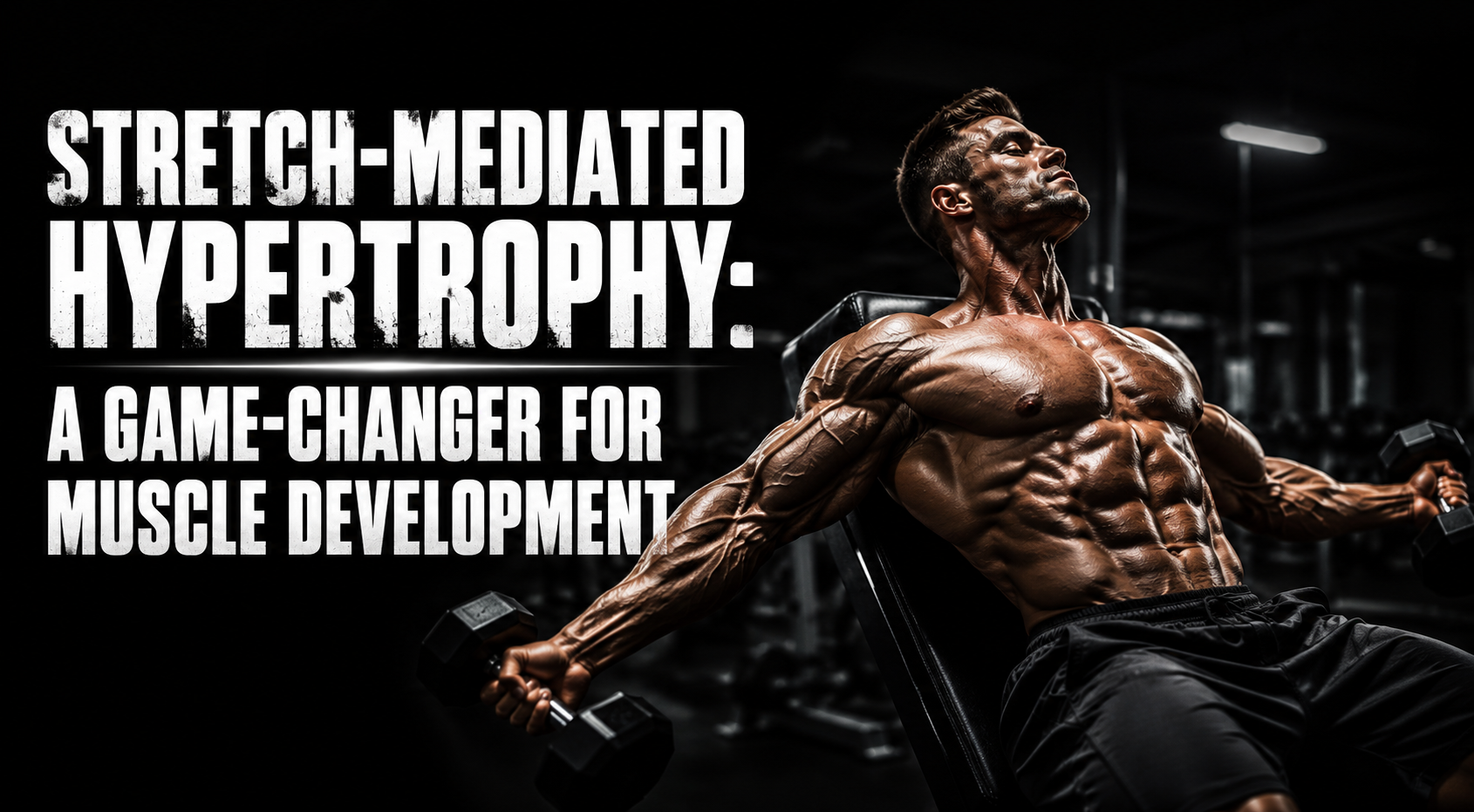
To apply stretch-mediated hypertrophy in practice, training should emphasize exercises that load muscles at long lengths, often through deep ranges of motion and controlled tempo work. For the chest, movements such as deep dumbbell flyes, cable crossovers with a pronounced stretch, and deficit push-ups are commonly used. For the arms, incline dumbbell curls, cable curls performed with the arms positioned behind the torso, and overhead triceps extensions are effective choices. The hamstrings respond well to seated leg curls and Romanian deadlifts performed with a controlled stretch at the bottom. Calf development can be targeted with straight-leg calf raises emphasizing a deep stretch, while quads may benefit from deep split squats, sissy squats, and ATG-style squatting variations.
Despite its effectiveness, this approach should not completely replace traditional training methods. Instead, it can be integrated strategically. A practical approach is to include one to two additional sets per muscle group each week that focus specifically on long-length training. These should be performed with moderate loads, slow eccentric phases of around three to five seconds, and brief pauses in the stretched position lasting one to three seconds. Some lifters also incorporate partial repetitions in the bottom range to further emphasize the stretch.
It is important to note that stretch-focused training can be extremely demanding. The intense mechanical tension created in lengthened positions often leads to significant muscle soreness, especially for those new to this style of training. While this discomfort is often associated with productive adaptation, recovery must be carefully managed. Starting with low volume and gradually increasing workload is recommended to avoid excessive fatigue or overtraining.
Overall, stretch-mediated hypertrophy represents a meaningful evolution in resistance training philosophy. It suggests that the bottom portion of a lift—the stretched position—may be just as important, if not more so, than the peak contraction. For those looking to break through plateaus or develop more complete muscular development, incorporating long-length training may provide a valuable edge.
Was this article helpful?
That’s Great!
Thank you for your feedback
Sorry! We couldn't be helpful
Thank you for your feedback
Feedback sent
We appreciate your effort and will try to fix the article